Whether you get your water from a municipal supply line or a private well, understanding exactly what comes out of your tap is essential for protecting your family’s health, preserving your household plumbing, and ensuring the longevity of your appliances. In Northern California, water dynamics are highly localized. From the coastal flats of Live Oak to the heavily forested slopes of Boulder Creek, water quality can vary significantly from one geographical area to the next.
This comprehensive guide answers the most pressing questions homeowners ask about water testing. We also explain why localized testing is vital across Santa Cruz County and explore advanced treatment solutions tailored to solve your specific water quality challenges.
Why Water Testing in Santa Cruz and Surrounding Areas is Essential
Santa Cruz County features a remarkably complex hydrological landscape. Depending on your exact location, your water might come from local rivers, groundwater basins, or private mountain springs. Each source carries unique geological and environmental risks that affect water quality.
- Santa Cruz & Live Oak: Municipal water systems here rely heavily on surface water from the San Lorenzo River and coastal streams, supplemented by groundwater. Surface water is highly susceptible to seasonal fluctuations, runoff, and municipal disinfection byproducts.
- Scotts Valley: Residents primarily draw from groundwater aquifers. While typically well-filtered by nature, groundwater in this region is notorious for high mineral content—specifically calcium and magnesium—leading to severe hard water problems.
- Boulder Creek & San Lorenzo Valley: Many properties in these mountainous areas rely strictly on private wells or small, localized water companies. Private wells draw from aquifers that can absorb naturally occurring heavy metals, iron, manganese, or agricultural runoff, and are highly vulnerable to bacterial intrusion.
What Does a Water Test Reveal?
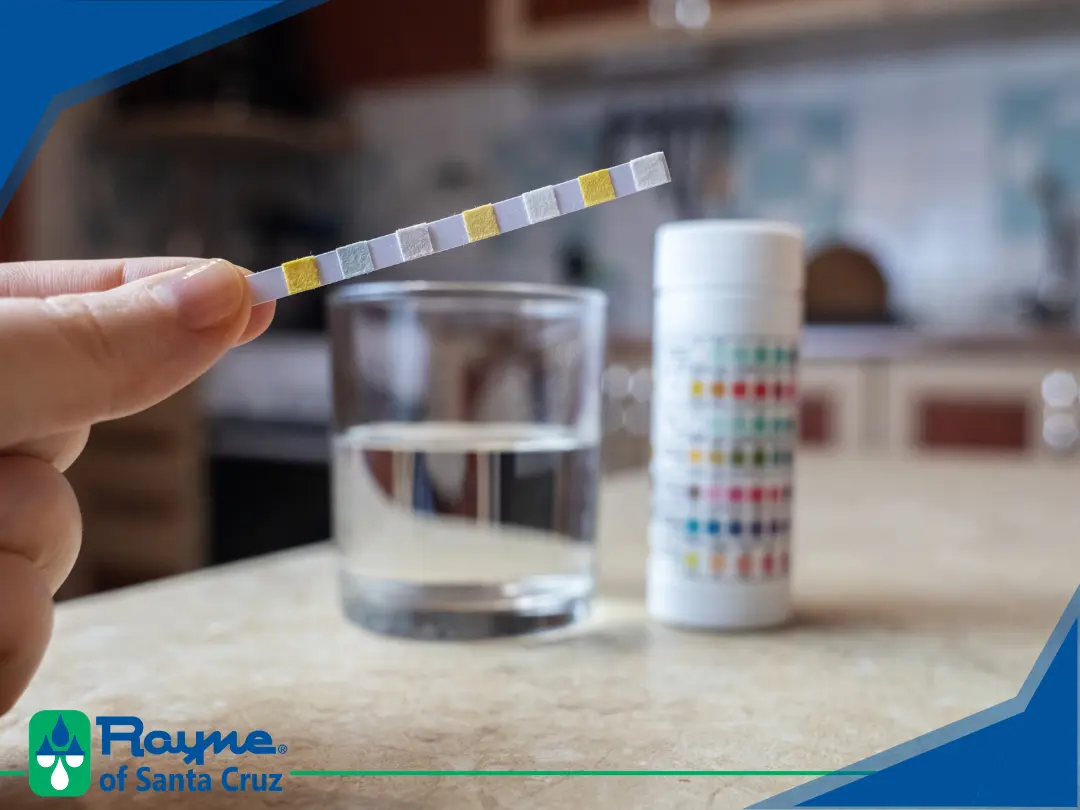
To the naked eye, your water might look perfectly crystal clear. However, many of the most problematic water issues are invisible, odorless, and tasteless. Professional water testing pulls back the curtain on your water chemistry, revealing several critical metrics:
1. Hardness Minerals
High concentrations of calcium and magnesium cause scale buildup inside pipes, hot water heaters, and household appliances. This dramatically reduces their energy efficiency and shortens their lifespans.
2. Total Dissolved Solids (TDS)
This measures the combined organic and inorganic substances dissolved in your water. High TDS levels can cause an unpleasant, metallic, salty, or bitter taste.
Learn more: Understanding TDS (Total Dissolved Solids) and Its Impact on Water Quality
3. Heavy Metals & Minerals
Water tests pinpoint elevated levels of iron, manganese, copper, and lead. Iron and manganese leave unsightly red, brown, or black stains on plumbing fixtures and laundry, while lead and copper pose direct health risks.
Learn more: 7 Common Signs Your Home Needs an Iron Filter
4. Biological Contaminants
Especially critical for private wells, water testing checks for the presence of coliform bacteria and E. coli, indicating potential sewage or surface runoff contamination.
5. Chemical and Environmental Pollutants
This includes nitrates from fertilizers or septic systems, volatile organic compounds (VOCs), and chlorine/chloramines used by city facilities for disinfection.
How Often is Water Testing Recommended?
The frequency of your water testing schedule depends heavily on the source of your household water supply.
Water Testing Recommendations for Homes on Private Wells
Unlike city water systems, private wells are completely unregulated by federal and state agencies. The homeowner bears full responsibility for safety. It is strongly recommended to conduct a basic water testing panel at least once a year for bacteria, nitrates, total dissolved solids, and pH. Furthermore, you should test immediately if you notice changes in taste, color, or odor, or following severe weather conditions like heavy flooding or nearby wildfires, which can compromise wellheads.
Water Testing Recommendations for Homes on Municipal (City) Water
Municipalities are legally mandated to test water at the treatment facility and distribute annual water quality reports. However, city testing does not account for the miles of aging infrastructure, main breaks, or the specific condition of your home’s internal plumbing lines. Testing municipal water is recommended every 2 to 3 years, or immediately if you experience persistent white scale buildup, chlorinated odors, or unexplained staining on fixtures.
Matching Your Water Test Results to the Right Treatment System
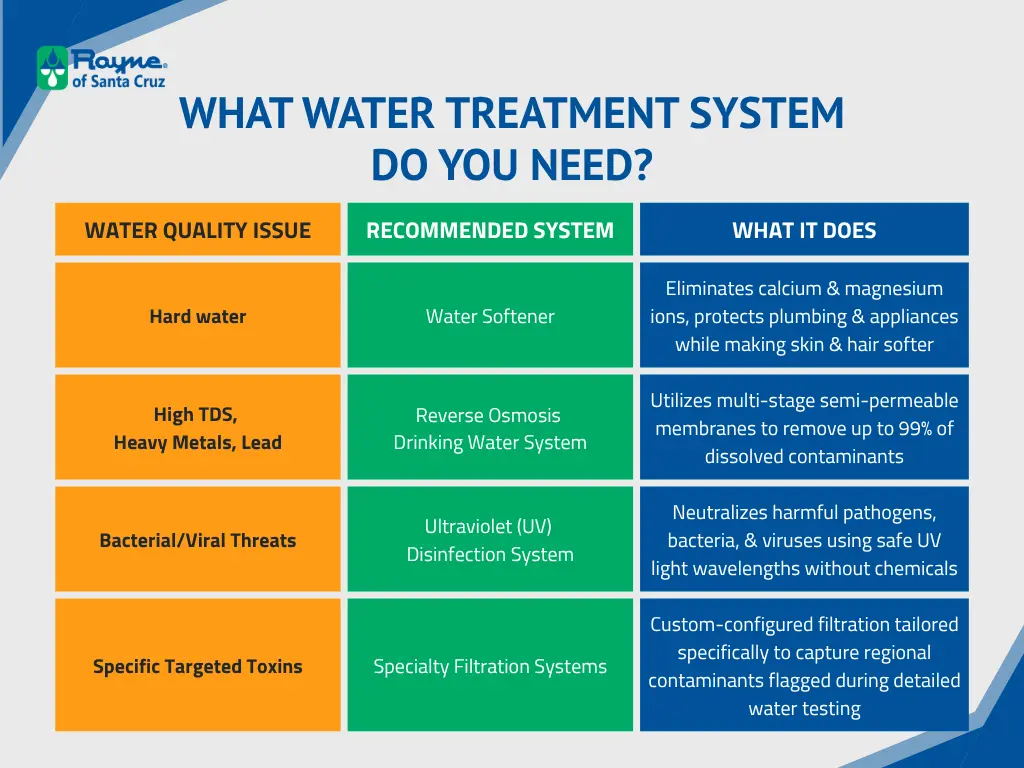
Once a water test exposes your specific water profile, the next step is applying targeted filtration. At Rayne of Santa Cruz, we offer a broad range of specialized water treatment systems engineered to address problems revealed by your water test. Take a look at the chart below to see some of the water quality issues most commonly solved by our filtration systems.
Take Control of Your Household Water Quality Today
Are you curious about what’s hiding in your home’s tap water? You don’t have to guess! At Rayne of Santa Cruz, we provide a free basic water test to homeowners within our service area, including Santa Cruz, Boulder Creek, Scotts Valley, Live Oak, and surrounding neighborhoods. Simply contact us today to schedule your test and get the data you need to make informed decisions about your water.