If you want better water at home, you may find yourself comparing two popular options: a whole house water filter and a reverse osmosis system.
But when comparing a whole house water filter vs. reverse osmosis, there’s an important point to understand from the beginning: these systems aren’t necessarily competitors.
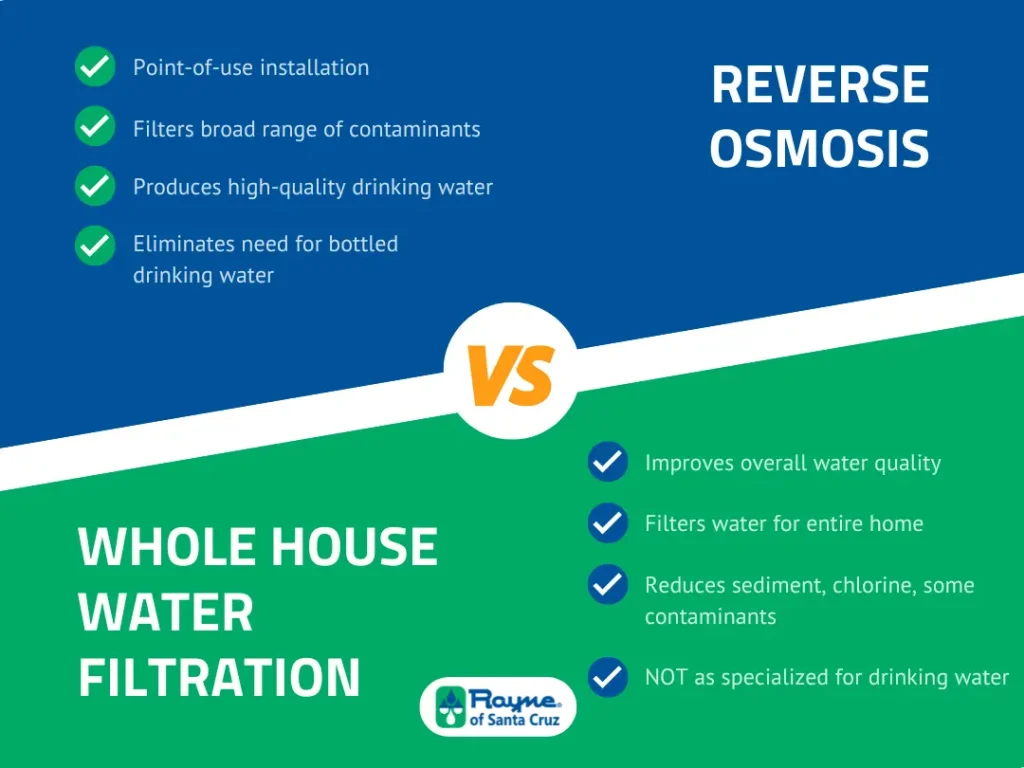
A whole house water filter is typically designed to address specific water quality concerns throughout your home. A reverse osmosis (RO) system, on the other hand, is commonly installed at a point of use, such as the kitchen sink, to provide highly filtered water for drinking and cooking.
Depending on what’s in your water and what you want to improve, you might need one, the other—or both.
For homeowners in Santa Cruz County, the best place to start is with your actual water quality. Whether you receive municipal water or have a private well can also significantly affect which water treatment solutions make sense.
Let’s compare whole house water filtration vs. reverse osmosis and help you understand the role each system can play in improving your home’s water.
What’s the Difference Between a Whole House Water Filter and Reverse Osmosis?
The biggest difference is where the water is treated and what you’re trying to remove or reduce.
A whole house water filter, also known as a point-of-entry system, treats water as it enters your home. Depending on the filtration media and equipment used, it can address specific concerns before water reaches your showers, washing machine, bathrooms, kitchen and other fixtures.
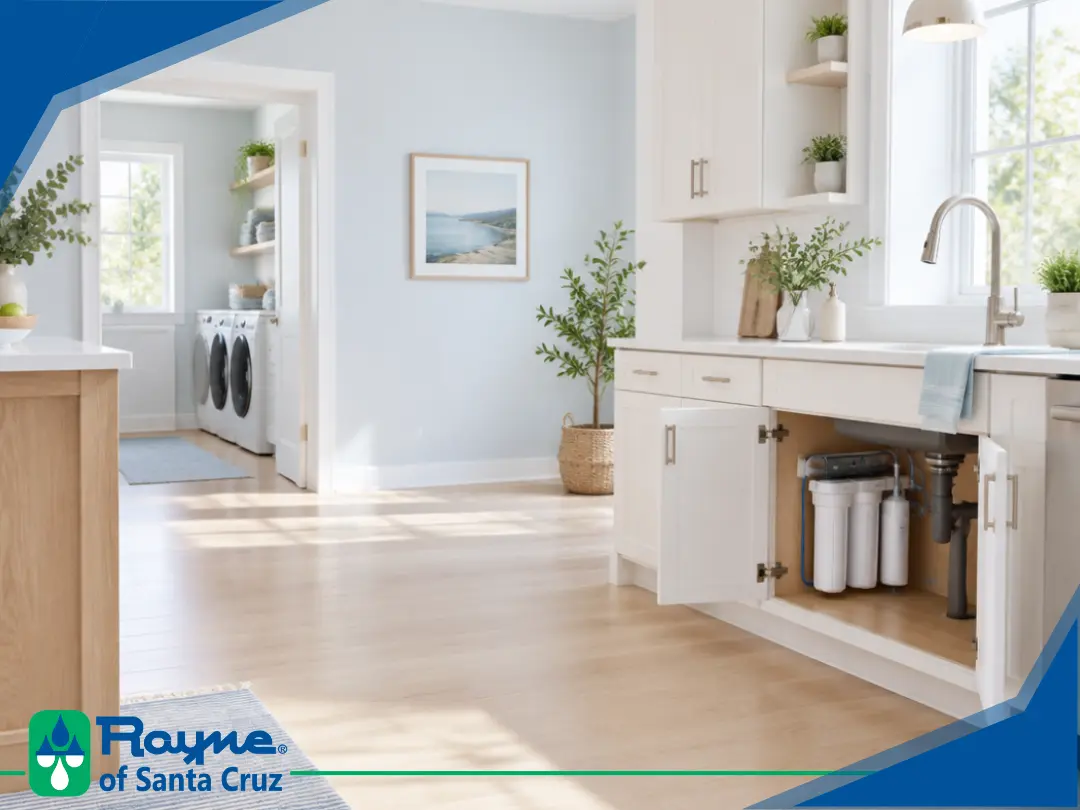
A typical residential reverse osmosis system is a point-of-use system. Rather than treating every gallon entering the house, it produces highly filtered water where you need it most—usually at the kitchen sink.
Here’s a quick comparison:
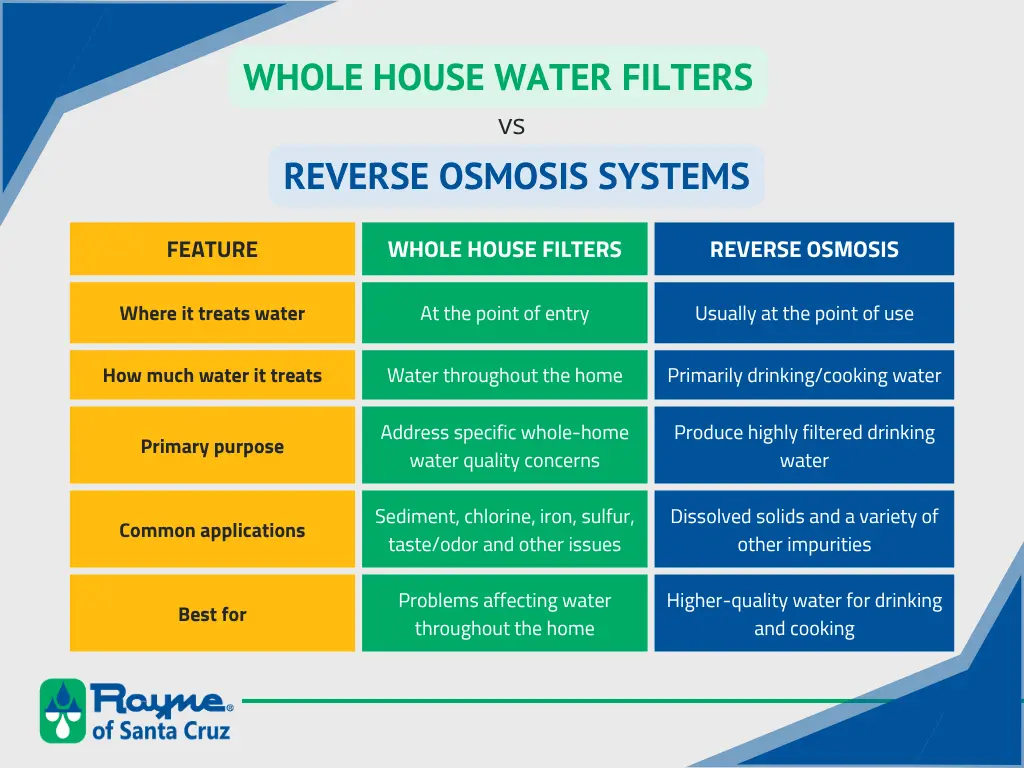
The important takeaway is that “whole house filter” describes where treatment occurs more than exactly what the system removes. Whole house filters can use different technologies and media depending on the water problem being treated.
That’s why testing your water before choosing equipment is so important.
What Is a Whole House Water Filter?
A whole house water filtration system is installed on the main water line so water can be treated before being distributed throughout your home.
The exact system depends on the problem.
For example, whole house filtration may be designed to address issues such as:
- Sediment
- Chlorine
- Unpleasant tastes and odors
- Iron
- Manganese
- Hydrogen sulfide or “rotten egg” odors
- Other water quality concerns identified through testing
This can be particularly important for homes with private wells because well water chemistry can vary significantly from property to property.
The result is treatment that’s targeted to your home’s actual water rather than relying on a one-size-fits-all filter.
What Is Reverse Osmosis?
Reverse osmosis uses water pressure and a semipermeable membrane as part of a multi-stage treatment process.
The membrane allows water molecules to pass through while rejecting many dissolved substances. Depending on the system and water chemistry, RO can significantly reduce a variety of dissolved solids and other impurities.
For a homeowner, the most important difference is how RO is typically used.
Instead of processing all of the water required for showers, toilets and laundry, a residential reverse osmosis drinking water system focuses treatment where highly filtered water provides the greatest benefit: drinking, cooking and food preparation.
An under-sink RO system can give you convenient access to high-quality drinking water without relying on cases of bottled water.
Whole House Water Filter vs. Reverse Osmosis: Which Removes More?
This question can be misleading because the two systems have different jobs.
Reverse osmosis provides very thorough filtration at a specific point of use. A whole house filter treats a much greater volume of water, but exactly what it removes depends on the filtration technology selected.
For example, a whole house filter designed to reduce chlorine isn’t the same as one designed to address iron or hydrogen sulfide in well water.
Think of it this way:
- Whole house filtration asks: “What problems do we need to address throughout the home?”
- Reverse osmosis asks: “How can we produce exceptionally high-quality water for drinking and cooking?”
Once you look at the systems this way, it becomes easier to understand why many households can benefit from both.
When Does a Whole House Water Filter Make Sense?
A whole house system is particularly useful when the problem affects water throughout your home—not just the water you drink.
Consider whole house filtration if you’re dealing with issues such as:
Chlorine Taste or Odor Throughout the Home
Municipal water is disinfected before it reaches your home. If you find chlorine taste or odor objectionable, appropriate whole house filtration can reduce chlorine before the water reaches faucets and showers.
Sediment in Your Water
Visible particles or sediment may require filtration before water moves through your plumbing and fixtures.
Well Water With Iron or Manganese
Private wells can contain elevated concentrations of iron, manganese and other substances. Specialized filtration may be needed depending on test results.
Rotten Egg or Sulfur Odors
Hydrogen sulfide can create the unmistakable smell of rotten eggs. A properly selected treatment system can address the source rather than simply filtering the water you drink.
Other Whole-Home Water Quality Problems
If you’re experiencing a problem in your showers, laundry, bathrooms and kitchen, treating only one faucet won’t solve the underlying whole-home issue.
That’s where point-of-entry treatment has an advantage.
When Does a Reverse Osmosis System Make Sense?
Reverse osmosis is especially useful when your priority is high-quality drinking and cooking water.
An RO drinking water system may be a good choice if:
- You don’t like the taste or odor of your tap water
- You’re concerned about dissolved solids or specific substances that RO is designed to reduce
- You regularly purchase bottled drinking water
- You want filtered water readily available for drinking and cooking
- You want a dedicated drinking water treatment system in addition to other whole-home treatment
RO can also complement municipal water treatment. Public water may meet applicable drinking water standards while still containing substances that affect taste or that homeowners would prefer to further reduce at the tap.
Do You Need a Whole House Water Filter AND Reverse Osmosis?
Sometimes, yes.
This is one of the most important things to understand when comparing a whole house water filter vs. reverse osmosis.
Using both systems can provide two levels of treatment:
Level 1: Whole-home treatment
Water is treated when it enters the home to address the specific issues affecting your overall water supply.
Level 2: Drinking water treatment
Reverse osmosis provides additional treatment at the kitchen for water used for drinking, beverages, cooking and food preparation.
Instead of asking, “Which system is better?” it can be more helpful to ask: “What do I want my water treatment system to accomplish?“
If you want to address a whole-home problem and want highly filtered drinking water, combining treatment technologies may provide the most comprehensive solution.
Example 1: You’re on Santa Cruz City Water and Don’t Like the Taste
Suppose your primary concerns are chlorine taste and odor throughout your home, but you also want high-quality water for drinking and cooking.
A whole house filtration system designed for your municipal water could address chlorine throughout the house.
Then, an RO drinking water system could provide an additional level of filtration at your kitchen sink.
In this situation, the systems complement one another.
Example 2: You Have a Private Well With Iron and Poor-Tasting Drinking Water
Well owners have different responsibilities and challenges.
Unlike customers of a municipal water utility, private well owners are responsible for monitoring their own water quality. Well water can contain iron, manganese, hydrogen sulfide, hardness and other substances that may require treatment.
If testing identifies iron, for example, a specialized whole house filter could address the problem before the water is distributed throughout your home.
An RO system could then provide additional treatment for drinking and cooking water.
The right configuration depends on the results of professional water testing.
Example 3: Your Only Concern Is Drinking Water
What if you’re generally satisfied with your household water but want better-tasting, more highly filtered water for drinking?
You may not need a whole house filtration system.
A reverse osmosis drinking water system could be the more targeted and cost-effective solution because you’re treating the water where you actually need additional filtration.
Example 4: You Have Hard Water
Here’s where another type of treatment enters the picture.
A water softener is not the same as either a whole house filter or a reverse osmosis drinking water system.
A traditional water softener is specifically designed to address hardness minerals such as calcium and magnesium.
If you have hard water and other water quality concerns, your ideal solution could involve multiple technologies:
- A water softener or other appropriate scale-control solution for hardness
- Specialized whole house filtration for other identified water concerns
- Reverse osmosis for high-quality drinking water
You shouldn’t automatically install all three. Instead, water testing can help determine which combination actually makes sense for your home.
Whole House Water Filter vs. Water Softener: Are They the Same?
No.
This is a common source of confusion.
A water softener primarily targets the calcium and magnesium responsible for hard water. These minerals can contribute to scale buildup, soap scum, spotting and other familiar hard-water problems.
A whole house filter targets other water quality concerns according to the type of filtration media and system being used.
If your biggest complaint is scale buildup, simply installing a general-purpose whole house filter may not solve the problem. You may need a water softener or another system specifically designed for hardness and scale control.
That’s another reason professional water testing is important: you want to treat the cause, not simply the symptom.
What About Whole House Reverse Osmosis?
Whole house reverse osmosis systems do exist, but they’re considerably different from the under-sink RO systems commonly used for residential drinking water.
Whole house RO may be appropriate for certain challenging water conditions, but it requires careful system design, sufficient storage and appropriate pre- and post-treatment.
For most homeowners simply seeking better drinking water, treating every gallon in the house to RO standards may be unnecessary.
A water treatment professional can determine whether whole house RO is warranted based on the source water and the problems that need to be solved.
What Water Treatment System Is Best for Santa Cruz City Water?
There’s no single treatment system that’s best for every Santa Cruz County household.
For homes served by municipal water, concerns may include chlorine, taste and odor, dissolved solids or hard water. The appropriate solution depends on which of those issues you actually want to address.
Rayne of Santa Cruz offers water treatment solutions for city water supplies, including:
- High-efficiency water softeners
- Whole-home filtration
- Drinking water systems
- Treatment designed to reduce chlorine
- Systems designed to reduce dissolved solids and improve taste and odor
The advantage of working with a local water treatment professional is that your system can be selected around both local water conditions and your specific goals.
What Water Treatment System Is Best for Santa Cruz County Well Water?
Private well water deserves an individualized approach.
Two wells—even in the same general area—can have very different water chemistry.
Potential well water concerns can include:
- Iron
- Manganese
- Hydrogen sulfide
- Hardness
- Low pH
- Sediment
- Microbiological concerns
- Other naturally occurring or environmental contaminants
Depending on testing, a well water treatment setup could include specialized whole house filtration, water softening, pH correction, disinfection technologies or reverse osmosis drinking water treatment.
In other words, don’t choose a filter based solely on what worked for a neighbor.
Test first and treat the water you actually have.
How Do You Choose Between Whole House Filtration and Reverse Osmosis?
Start with three questions.
1. What’s Actually in Your Water?
You can’t reliably choose treatment equipment without understanding the problem.
Water that tastes strange, smells bad, leaves stains or causes scale can have very different underlying causes. Water testing helps identify what needs to be treated.
2. Where Do You Want Better Water?
If you want to improve water throughout your house, whole-home treatment may be appropriate.
On the other hand, if your concern is primarily drinking and cooking water, a point-of-use RO system may make more sense.
If both are important, you may benefit from both systems.
3. Are You Treating City Water or Well Water?
Municipal and private well water present different considerations.
Municipal water has already undergone treatment and disinfection before reaching your home. A private well puts responsibility for monitoring and treating water quality on the homeowner.
That distinction can significantly affect the equipment your home needs.
FAQs About Whole House Water Filters vs. Reverse Osmosis
Is reverse osmosis better than a whole house water filter?
Neither is universally better. They perform different jobs. Whole house filtration treats specific water concerns throughout the home, while residential RO typically provides highly filtered drinking and cooking water at a specific faucet.
Can I use a whole house water filter and reverse osmosis together?
Yes. The two can work very well together. Whole house filtration can address problems affecting water throughout your home, while RO provides an additional level of treatment for drinking and cooking water.
Do I need reverse osmosis if I already have a whole house filter?
It depends on what your whole house filter treats and the quality of drinking water you want. Whole house filtration doesn’t necessarily provide the same level or type of treatment as a reverse osmosis drinking water system.
Do I need a whole house filter if I have reverse osmosis?
Not necessarily. If your only concern is drinking water, RO may be enough. But if you have sediment, chlorine, iron, sulfur odors or another issue affecting water throughout your home, whole house treatment may also be beneficial.
Does a whole house water filter remove hard water?
Not necessarily. Standard filtration isn’t the same as water softening. If calcium and magnesium hardness minerals are causing scale and other hard water problems, you may need a water softener or another treatment specifically designed for hardness.
Does reverse osmosis remove hard water minerals?
RO can reduce dissolved minerals in the water passing through it, but a typical under-sink RO system isn’t intended to solve hard water problems throughout an entire home. Whole-home water hardness is generally addressed with water softening or appropriate scale-control technology.
Is whole house filtration good for well water?
It can be, but the filtration system needs to match the well’s actual water chemistry. Testing may identify iron, manganese, sulfur, sediment, low pH, hardness or other concerns that require different treatment technologies.
Should I test my water before buying a filtration system?
Yes. Testing helps identify the problems that actually need treatment so you don’t invest in equipment that isn’t designed for your water.
Stop Guessing About Which Water Treatment System You Need
When comparing a whole house water filter vs. reverse osmosis, don’t think of the decision as simply choosing one winner.
Instead, think about what you want to accomplish.
Do you have a water quality problem affecting your entire home? A properly selected whole house filtration system may be the answer.
Do you want high-quality drinking and cooking water from your kitchen faucet? A reverse osmosis drinking water system may be ideal.
Want both? The two systems can work together as part of a comprehensive home water treatment solution.
Rayne of Santa Cruz has been serving Santa Cruz County since 1963, helping homeowners address water quality concerns in both municipal and private well water. Our water treatment experts can test your water and recommend a solution based on what’s actually in it—not guesswork.
Schedule a FREE professional water quality test with Rayne of Santa Cruz today and find out whether a whole house filter, reverse osmosis system or customized combination is right for your home.