A reverse osmosis (RO) drinking water system provides convenient access to filtered water right from your kitchen faucet. But what happens when the water starts trickling out instead of flowing normally? Or when your RO storage tank takes much longer than usual to refill?
Reverse osmosis slow water flow is a common problem that can result from clogged filters, incorrect storage tank pressure, a worn RO membrane, or insufficient household water pressure. In many cases, routine maintenance can restore normal performance. However, persistent flow problems may indicate that your system needs professional service or replacement.
If you’re experiencing low RO water pressure or your RO tank is not filling, understanding the possible causes can help you determine what to do next.
Below, we’ll explain why reverse osmosis systems sometimes slow down, what you can safely check yourself, and how Rayne of Santa Cruz can help you enjoy reliable, high-quality drinking water again.
Is It Normal for a Reverse Osmosis System to Produce Water Slowly?
Yes, to a certain extent. Reverse osmosis systems naturally produce purified water more slowly than water flows from a standard kitchen faucet.
That’s because RO systems use a semipermeable membrane to separate water from many dissolved contaminants. The membrane requires sufficient pressure to move water through it, and the purified water is typically collected in a storage tank before being dispensed through a dedicated faucet.
However, there is a difference between normal RO operation and a system that’s no longer performing properly.
A properly functioning residential RO system should generally provide a usable stream of water from its faucet when the storage tank is full. The exact flow rate and tank refill time depend on the system’s design, water pressure, temperature, and membrane capacity.
Signs Your RO System May Have a Problem
Watch for these common symptoms:
- Water comes out of the RO faucet in a weak trickle.
- The system produces less drinking water than it used to.
- Your RO storage tank takes unusually long to refill.
- The RO faucet initially flows normally but quickly slows down.
- The storage tank feels full, but very little water comes out.
- Water tastes different or the system is overdue for maintenance.
If you notice one or more of these issues, the following problems may be responsible.
1. Clogged Prefilters Are Restricting Water Flow
One of the most common causes of reverse osmosis slow water flow is a clogged prefilter.
Most RO drinking water systems use several filtration stages. Before water reaches the reverse osmosis membrane, it typically passes through sediment and carbon prefilters.
These filters serve different purposes:
- Sediment filters capture particles such as sand, dirt, and rust.
- Carbon filters reduce chlorine and certain other substances that can affect water quality and damage some RO membranes.
- RO membranes reduce many dissolved substances that pass through conventional filtration.
Over time, prefilters can accumulate material and restrict the amount of water reaching the RO membrane.
When this happens, the system may produce purified water much more slowly.
How to Fix Clogged RO Prefilters
Check when your filters were last replaced.
Many residential RO systems require prefilter replacement approximately every 6–12 months, although the correct interval depends on the manufacturer’s instructions, water quality, and usage.
Homes with higher sediment levels may require more frequent maintenance.
If your system has gone longer than recommended without a filter change, replacing the appropriate filters may restore normal water production.
Important: Use filters designed for your specific RO system. Incorrect cartridges or improperly installed filters can create additional performance problems.
2. Incorrect Storage Tank Pressure Is Causing Low RO Water Pressure
If water initially flows from your RO faucet but quickly slows to a trickle, your storage tank may be part of the problem.
Most traditional under-sink reverse osmosis systems use a pressurized storage tank to hold purified water until you need it.
Inside the tank, an air charge helps push stored water toward the faucet.
When that air pressure becomes too low, the tank may contain water but lack sufficient pressure to deliver it effectively.
Excessive air pressure can also interfere with the tank’s ability to store water.
How to Tell If Your RO Tank Pressure Is Wrong
Common symptoms include:
- Water flows normally for a few seconds before slowing dramatically.
- The storage tank feels heavy but produces very little water.
- The faucet has consistently weak pressure even after the tank has had time to refill.
- The tank does not appear to fill to its normal capacity.
Can You Adjust RO Storage Tank Pressure Yourself?
Some manufacturers provide instructions for checking and adjusting the tank’s air charge.
However, the correct pressure depends on the system and must generally be checked with the water side of the tank completely depressurized.
Adding air without following the manufacturer’s instructions can make the problem worse.
If you’re unsure how to check the pressure safely, professional troubleshooting is the better option.
A technician can determine whether the tank needs adjustment, has a damaged internal bladder, or requires replacement.
3. Your Reverse Osmosis Membrane May Be Clogged or Worn Out
The RO membrane is one of the most important components of your drinking water system.
It is responsible for reducing many dissolved substances, including certain minerals and other contaminants.
However, membranes don’t last forever.
Over time, an RO membrane can become fouled or scaled by substances in the incoming water. This can restrict purified water production and contribute to low RO water pressure.
What Causes RO Membrane Problems?
Several factors can affect membrane performance:
- High mineral content or hardness in the incoming water
- Sediment or other contaminants that reach the membrane
- Inadequate prefilter maintenance
- Exposure to chlorine when the membrane is not designed to tolerate it
- Normal membrane aging
- Inadequate incoming water pressure
How Often Should an RO Membrane Be Replaced?
RO membrane lifespan varies considerably depending on the system, incoming water quality, and maintenance.
Some residential membranes can perform effectively for several years, but others may need replacement sooner.
Signs that membrane service may be needed include reduced water production, declining water quality, or test results showing reduced contaminant rejection.
Keep in mind that slow water flow alone doesn’t prove the membrane is failing. A qualified technician can evaluate water pressure, membrane performance, and other components before recommending replacement.
If the membrane is still in good condition, the issue may be resolved without replacing it.
4. Low Household Water Pressure Is Affecting Your RO System
Reverse osmosis systems rely on adequate incoming water pressure to move water through the membrane.
If your home’s water pressure is too low, your RO system may struggle to produce and store purified water efficiently.
This is especially important because the pressure needed for effective RO operation can be higher than what is required for ordinary faucet use.
What Causes Low Incoming Water Pressure?
Possible causes include:
- Low municipal water supply pressure
- Pressure regulator problems
- Partially closed shutoff valves
- Restrictions in plumbing or supply lines
- Pressure fluctuations during periods of high household water use
- Well pump or pressure tank problems in homes with private wells
Some residential RO systems require approximately 40–60 psi or more at the inlet for effective operation, but pressure requirements vary by model. Always refer to your manufacturer’s specifications.
What Can You Do About Low Household Water Pressure?
First, determine whether the problem affects your entire home or only your RO faucet.
If multiple faucets have weak pressure, the problem may be related to your household plumbing or water supply.
If other fixtures work normally, the issue may be isolated to the RO system or its supply connection.
Some RO systems can be equipped with a compatible booster pump when incoming pressure is insufficient.
However, adding a pump isn’t always the correct solution. A professional should verify the cause of the pressure problem and confirm that any equipment is appropriate for the system.
5. Your RO Storage Tank Isn’t Filling Properly
Another common complaint is an RO tank not filling, even after the system has been running for several hours.
This problem can have several possible causes, including:
- Clogged prefilters
- A fouled RO membrane
- Insufficient incoming water pressure
- Incorrect storage tank air pressure
- A malfunctioning automatic shutoff valve
- A restricted supply line or flow-control component
- A faulty check valve
Because multiple components can produce similar symptoms, replacing the membrane or storage tank without testing may not solve the problem.
How Long Should an RO Tank Take to Fill?
There isn’t one universal refill time.
A conventional residential RO tank may take several hours to refill after being completely emptied, depending on membrane capacity, water temperature, pressure, tank size, and system design.
Cold water can also reduce membrane production, so some seasonal variation is normal.
If your system suddenly takes much longer than it used to, or the tank never seems to reach its normal capacity, it’s worth investigating.
6. A Kinked Water Line or Faulty Valve Is Restricting Flow
Sometimes the cause of slow RO water flow is relatively simple.
A kinked tube, partially closed supply valve, or restricted faucet connection may prevent water from moving freely through the system.
Other possible problems include a malfunctioning automatic shutoff valve or a clogged postfilter.
A postfilter is typically installed after the storage tank to provide a final filtration stage before water reaches the faucet. If this filter becomes restricted, the tank may be full even though faucet flow remains weak.
What Should You Check?
Without disassembling the system, you can look for:
- Visible kinks in accessible tubing
- A supply valve that appears partially closed
- Signs of leaks around the system
- A filter replacement date that’s overdue
- An obvious obstruction or damage to the faucet
Avoid disconnecting pressurized tubing or taking apart valves unless you’re familiar with the system and the manufacturer’s procedures.
Reverse Osmosis Slow Water Flow: Quick Troubleshooting Guide
The following table can help you identify possible causes based on what you’re experiencing.
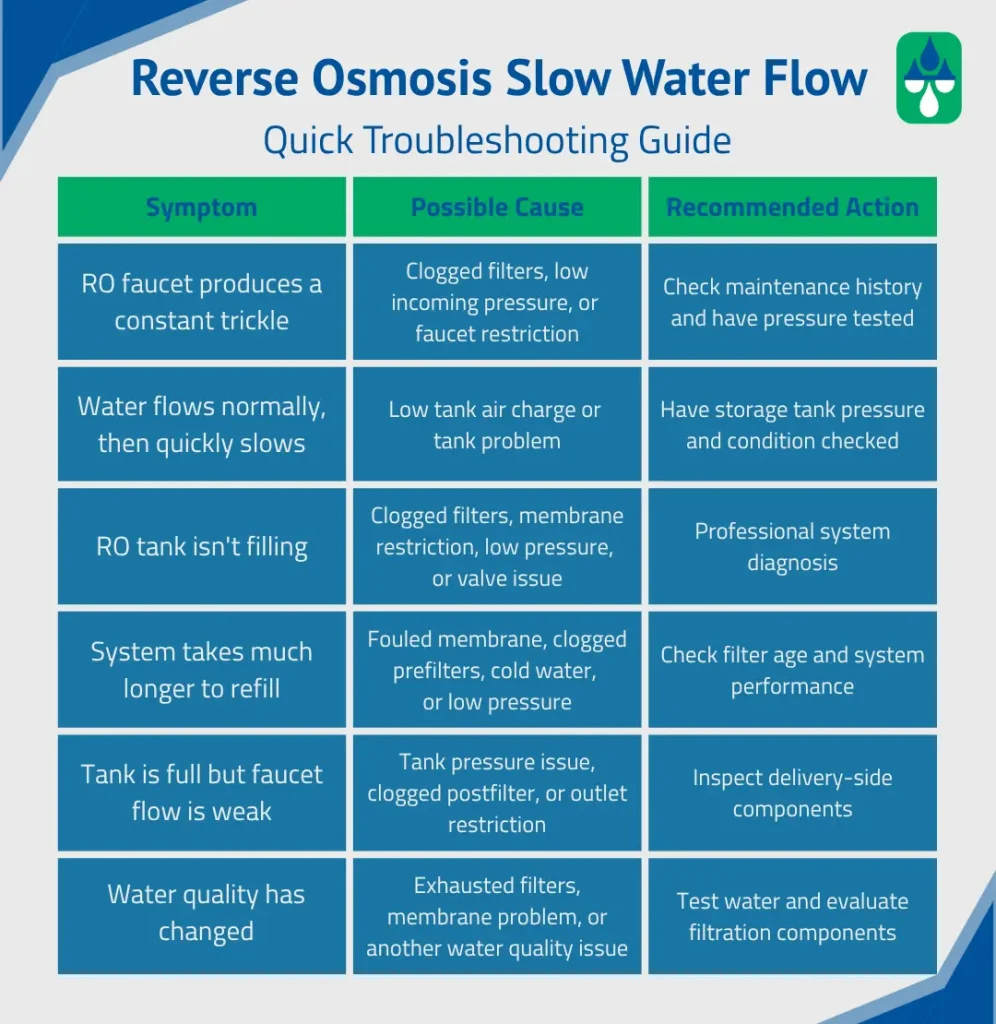
The key takeaway: Slow water flow doesn’t automatically mean you need a new reverse osmosis system. Many problems can be corrected with maintenance or replacement of individual components.
When Should You Repair Your RO System vs. Replace It?
Reverse osmosis systems can provide years of dependable drinking water filtration when properly maintained.
However, there comes a point when repairing an aging system may no longer be the most practical or economical choice.
When RO System Repair May Be the Better Option
Repair or maintenance may make sense when:
- The system is relatively new and otherwise performs well.
- The problem is caused by overdue filter replacement.
- Storage tank pressure simply needs adjustment.
- A single valve, fitting, or other replaceable component has failed.
- The RO membrane is still performing properly.
- Replacement parts are readily available.
- The repair cost is reasonable compared with a new system.
Routine filter and membrane replacements are normal maintenance and don’t necessarily indicate that the system is failing.
6 Signs It May Be Time for a New Reverse Osmosis System
1. Your System Is Aging and Needs Frequent Repairs
Many residential RO systems can remain useful for 10 years or longer with proper maintenance, but lifespan varies by equipment quality, water conditions, and replacement-part availability.
If your system is aging and repeatedly requires service, upgrading may be more cost-effective than continuing to repair it.
2. Replacement Parts Are Difficult to Find
Older RO systems may use discontinued components or proprietary filters that are expensive or difficult to obtain.
A newer system with readily available replacement filters can simplify maintenance.
3. Water Production Remains Poor After Repairs
If new filters, proper tank pressure, and other maintenance steps haven’t restored performance, a more extensive system evaluation may be needed.
If multiple major components are deteriorating, replacement may be worth considering.
4. Your Household Needs Have Changed
Perhaps your family has grown, you’re filling reusable water bottles more frequently, or you use purified water for cooking and appliances.
A higher-capacity RO system may better accommodate your current water consumption.
5. You Want Improved Convenience or Efficiency
Newer RO systems may offer features such as:
- Higher purified water production capacity
- More convenient filter replacement
- Improved water-use efficiency
- Compact tankless designs
- Integrated water quality monitoring
- Specialized filtration configurations
Not every newer system includes these features, so it’s important to compare models rather than assume an upgrade will automatically deliver better performance.
6. Your Current System No Longer Meets Your Water Treatment Needs
Water quality can change, and not every RO system is designed or certified to reduce the same contaminants.
If testing identifies substances that your existing system isn’t adequately addressing, upgrading to an appropriately certified drinking water treatment system may be necessary.
Is a New RO System Worth the Investment?
If your existing RO system needs frequent repairs, produces insufficient water, or no longer meets your household’s needs, a replacement can offer better long-term value.
However, the right decision depends on the system’s condition, repair costs, water quality, and your family’s drinking water requirements.
A professional evaluation can help you avoid unnecessary replacement while ensuring that your drinking water treatment system is functioning as intended.
How to Prevent Reverse Osmosis Slow Water Flow
Preventive maintenance is one of the best ways to keep your RO system performing properly.
Here are several practical steps:
- Replace filters on schedule. Follow the manufacturer’s recommendations and adjust maintenance intervals based on your water conditions.
- Monitor changes in faucet flow. A noticeable decline may be an early sign of a restriction or pressure problem.
- Check for leaks. Periodically inspect accessible tubing, fittings, and the area beneath your sink.
- Have membrane performance evaluated. Water testing can help determine whether the membrane is still reducing dissolved substances effectively.
- Maintain adequate incoming water pressure. Address household pressure issues that interfere with RO operation.
- Schedule professional service when needed. An experienced water treatment professional can identify problems that aren’t obvious from a visual inspection.
Regular maintenance helps protect your investment and supports consistent drinking water quality.
FAQs About Reverse Osmosis Slow Water Flow
Why is my reverse osmosis faucet barely producing water?
A weak RO faucet flow may be caused by clogged filters, low storage tank pressure, a restricted membrane, insufficient household water pressure, or a problem with a valve or water line. The correct repair depends on identifying which component is limiting flow.
Why is my RO tank not filling with water?
If your RO tank isn’t filling, the system may not have enough incoming pressure, the filters or membrane may be restricted, or a valve may not be operating correctly. A professional can test these components to determine the cause.
Can a clogged RO filter cause low water pressure?
Yes. As sediment and other material accumulate in a filter, they can restrict water flow. Replacing an overdue filter may improve performance, provided there isn’t another problem affecting the system.
How can I increase water pressure from my reverse osmosis system?
The solution depends on the cause. Replacing clogged filters, correcting storage tank pressure, removing line restrictions, or addressing insufficient inlet pressure may help. Some systems may benefit from a compatible booster pump, but the underlying issue should be diagnosed first.
Does a reverse osmosis system lose pressure as it gets older?
Not necessarily. Age alone doesn’t cause pressure loss, but components such as filters, membranes, storage tanks, and valves can deteriorate over time. Proper maintenance can help preserve system performance.
How do I know if my reverse osmosis membrane is bad?
Possible warning signs include declining water production or reduced contaminant rejection. However, these symptoms can have other causes. Testing membrane performance and checking system pressure can help determine whether replacement is necessary.
Should I replace my RO system if the water flow is slow?
Not automatically. Slow flow is often caused by a maintenance issue that can be repaired. Replacement becomes more reasonable when the system is aging, repeatedly needs repairs, has unavailable parts, or no longer meets your water treatment needs.
Get Reliable Drinking Water With Rayne of Santa Cruz
A slow reverse osmosis system can be frustrating, especially when you depend on filtered water for drinking, cooking, and everyday use.
Fortunately, reverse osmosis slow water flow doesn’t always mean your system needs to be replaced. The problem may be as simple as a clogged filter or incorrect storage tank pressure.
But if your system is older, requires frequent repairs, or isn’t producing enough water for your household, it may be time to consider a new RO drinking water system.
At Rayne of Santa Cruz, we help homeowners throughout Santa Cruz County find drinking water treatment solutions that fit their water quality concerns, household needs, and budgets.
Whether you’re experiencing low RO water pressure, considering an upgrade, or exploring reverse osmosis filtration for the first time, our team can help you understand your options.
Ready to enjoy dependable, great-tasting drinking water again? Contact us today to learn more about our reverse osmosis drinking water systems and find the right solution for your home.