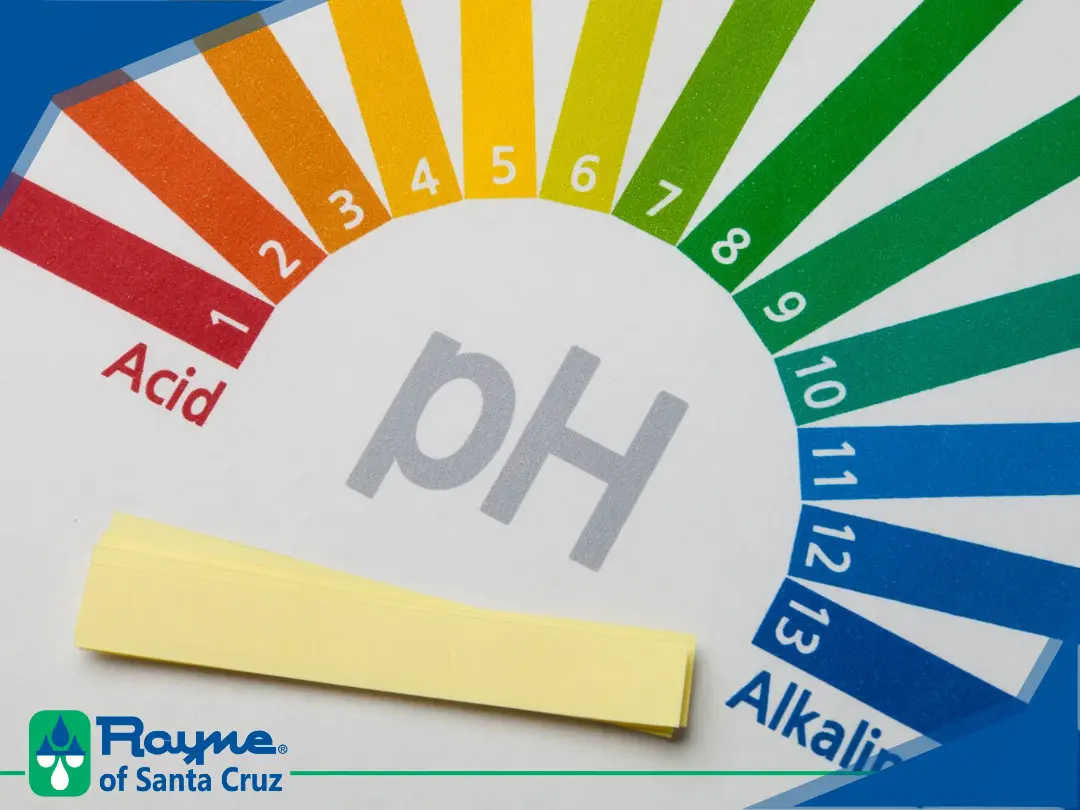
If your home relies on a private well, you probably pay attention to things like water pressure, unusual odors, or mineral buildup. But there’s another water quality issue that can quietly damage your plumbing: acidic well water.
Unlike hard water, which often leaves white, chalky deposits on faucets and fixtures, acidic water can actually corrode your plumbing system’s metal components. Over time, this may lead to blue-green stains, pinhole leaks, damaged fixtures, and costly repairs.
The good news? Acidic well water is often treatable once you understand what’s causing the problem.
For homeowners in Santa Cruz County and surrounding Central California communities, knowing the signs of low pH well water is an important step toward protecting your plumbing, appliances, and household water quality.
Let’s explore what acidic well water is, how to recognize it, and which water treatment solutions can help.
What Is Acidic Well Water?
Acidic well water is groundwater with a pH below 7.0. The lower the pH, the more acidic the water.
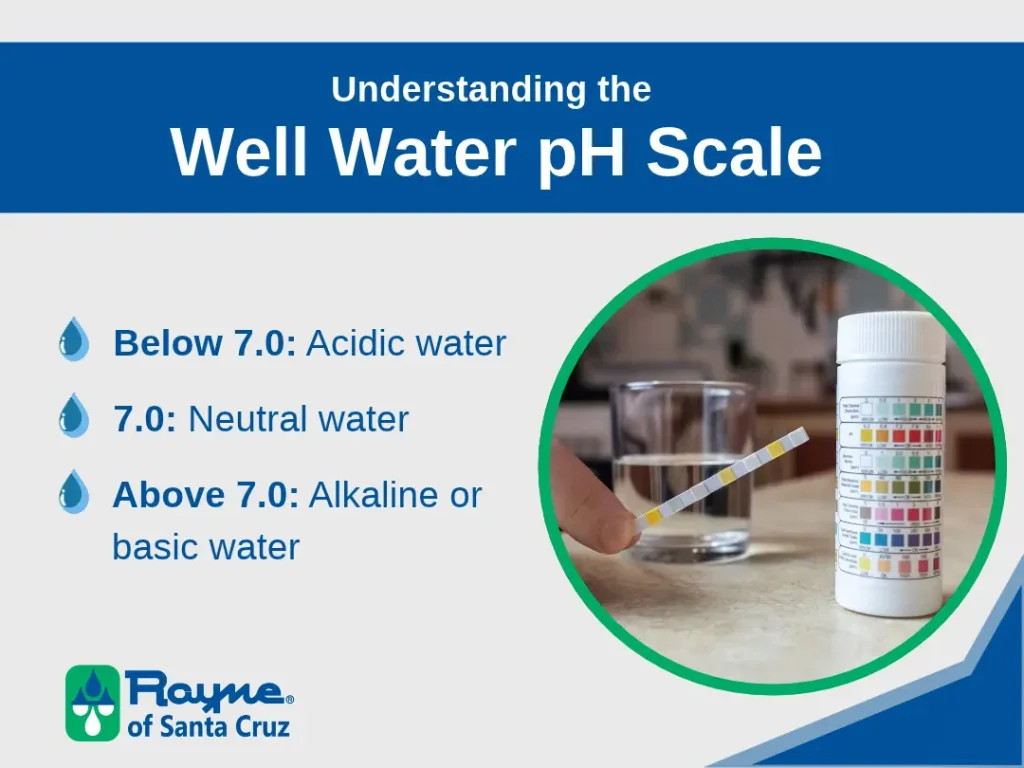
The pH scale measures how acidic or alkaline a substance is, typically on a scale from 0 to 14.
- Below 7.0: Acidic water
- 7.0: Neutral water
- Above 7.0: Alkaline or basic water
For household drinking water, a pH between 6.5 and 8.5 is generally considered a desirable range. However, water chemistry is more complicated than pH alone, and even water within this range can sometimes be corrosive.
Water with a pH below 6.5 is often a particular concern because it may contribute to corrosion of metal pipes, faucets, and plumbing fixtures.
Why Does Well Water Become Acidic?
Unlike municipal drinking water, which is typically treated and monitored by a public water supplier, private well water comes directly from underground sources.
As groundwater travels through soil, rock, and underground formations, it interacts with naturally occurring minerals, gases, and organic materials.
Several factors can contribute to low pH well water:
- Dissolved carbon dioxide: Carbon dioxide from the atmosphere or decomposing organic matter can dissolve into groundwater, forming weak carbonic acid.
- Local geology: Some underground formations contain relatively few minerals capable of naturally buffering acidity.
- Rainwater infiltration: Rainwater is naturally slightly acidic and may influence groundwater chemistry as it moves through soil.
- Decomposing vegetation: Organic material in the surrounding soil can affect groundwater chemistry.
Because groundwater conditions vary from one location to another, two neighboring properties may have very different well water characteristics.
That’s why professional water testing is so important for private well owners.
5 Common Signs of Acidic Well Water
Acidic water doesn’t always have an obvious smell, color, or taste. In fact, your water may look perfectly clear while gradually damaging your plumbing.
However, there are several warning signs that could indicate a low pH problem.
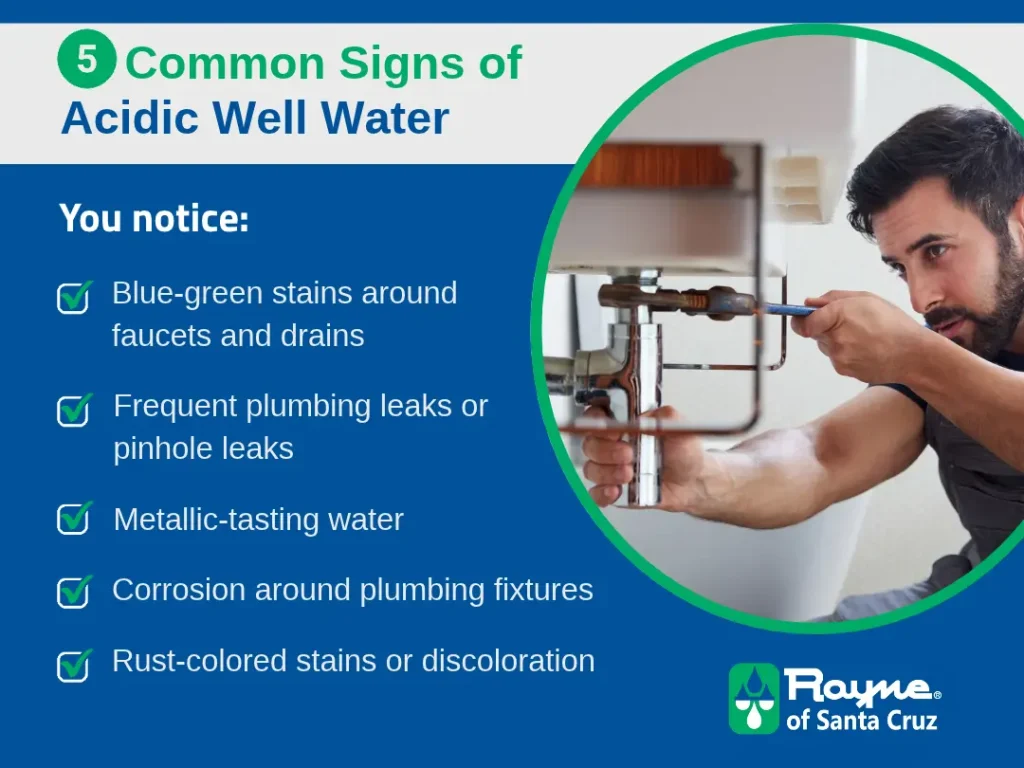
1. Blue-Green Stains Around Faucets and Drains
One of the most recognizable signs of acidic well water is the appearance of blue or green stains around sinks, bathtubs, shower drains, and faucets.
These stains are often associated with copper corrosion.
When corrosive water flows through copper plumbing, it can gradually dissolve small amounts of copper from the pipes. As copper-containing water comes into contact with air and surfaces, it may leave behind blue-green deposits.
If you repeatedly clean these stains only to have them return, your water chemistry may be contributing to the problem.
Important: Blue-green staining doesn’t automatically mean your well water is acidic. Other water chemistry factors can contribute to copper corrosion, so testing is necessary to determine the actual cause.
2. Frequent Plumbing Leaks or Pinhole Leaks
Have you noticed small leaks developing in copper pipes or plumbing connections?
Over time, corrosive water can weaken certain metal plumbing materials. In some cases, this deterioration results in tiny holes that allow water to escape.
These pinhole leaks can develop in areas that aren’t immediately visible, potentially causing damage inside walls, beneath floors, or around appliances.
Although plumbing leaks can have many causes, recurring leaks are a good reason to investigate your home’s water chemistry.
3. Metallic-Tasting Water
Some homeowners with corrosive water notice an unusual metallic taste when drinking water directly from the tap.
This may happen when water dissolves metals from household plumbing.
However, taste alone cannot determine whether water contains elevated levels of copper, lead, or other metals.
If your water has developed a metallic taste, consider having it professionally tested rather than assuming the issue is harmless.
4. Corrosion Around Plumbing Fixtures
Acidic water may contribute to premature deterioration of metal components throughout your home.
Possible signs include:
- Corroded faucet connections
- Deteriorating metal fittings
- Discoloration around plumbing fixtures
- Unexplained leaks near appliances
- Premature wear of certain plumbing components
These issues may develop gradually, making it easy to overlook the underlying water quality problem.
5. Rust-Colored Stains or Discoloration
Although blue-green stains are commonly associated with copper plumbing, acidic water can also affect iron-containing pipes and fixtures.
In homes with galvanized iron plumbing, corrosion may contribute to reddish-brown staining.
Keep in mind that iron naturally present in well water can also cause rust-colored stains. A water test can help distinguish between these different causes.
Is Acidic Well Water Dangerous to Drink?
The pH of water alone doesn’t necessarily indicate whether it’s safe to drink.
In fact, mildly acidic water isn’t automatically a direct health hazard. The bigger concern is often what acidic or corrosive water can do to your plumbing system.
As water travels through metal pipes and fixtures, corrosion may cause copper, lead, or other metals to enter the water.
Elevated concentrations of certain metals can pose health risks, especially for vulnerable populations.
It’s also important to understand that clear, odorless, and good-tasting water isn’t necessarily free of contaminants.
If you suspect your well water is acidic or corrosive, consider testing for pH and relevant metals, including copper and lead, as appropriate for your plumbing system.
A professional water quality evaluation can help determine whether additional laboratory testing is necessary.
How Do You Test for Low pH Well Water?
The most reliable way to determine whether your well water is acidic is to measure its pH.
Although home testing kits are available, a professional evaluation provides a more complete understanding of your water chemistry and can help identify factors that affect treatment recommendations.
What Should a Well Water Test Include?
Depending on your symptoms and the characteristics of your well, useful measurements may include:
- pH: Indicates whether your water is acidic, neutral, or alkaline.
- Alkalinity: Measures the water’s ability to resist changes in pH.
- Hardness: Identifies dissolved calcium and magnesium levels.
- Iron and manganese: Helps determine potential causes of staining.
- Total dissolved solids (TDS): Provides information about the overall concentration of dissolved substances.
- Copper and lead: May be recommended when plumbing corrosion is suspected.
Additional laboratory testing may be appropriate for bacteria, nitrates, arsenic, or other contaminants associated with private wells.
Free Basic Water Testing From Rayne of Santa Cruz
If you’re concerned about acidic well water, Rayne of Santa Cruz offers free basic water testing to help identify common water quality problems.
Our water treatment specialists can evaluate factors such as pH, hardness, iron, and dissolved solids and help determine whether more extensive laboratory testing is appropriate.
Because every private well is different, testing is the first step toward choosing an effective treatment system.
How Do You Treat Acidic Well Water?
For many homes with low pH well water, an acid neutralizer for well water is an effective treatment option.
These systems are designed to raise the pH of acidic water before it travels through the home’s plumbing system.
How Does an Acid Neutralization Filter Work?
An acid neutralization filter is typically installed where water enters the home so that it can treat the household water supply.
Many systems use a naturally occurring mineral called calcite, which is a form of calcium carbonate.
Here’s how the process works:
- Acidic water enters the filter. Water from the well flows into a tank containing neutralizing mineral media.
- The water contacts the calcite. The acidic water gradually dissolves a small amount of the mineral.
- The water’s pH increases. This reaction helps neutralize acidity and improves the water’s chemical balance.
- Treated water flows into the home. The adjusted water is generally less likely to cause corrosion associated with low pH.
A properly selected and maintained acid neutralization system can help reduce the risk of ongoing plumbing damage.
Benefits of an Acid Neutralization Filter
Depending on your water chemistry, an acid neutralization filter may help:
- Raise low well water pH
- Reduce corrosion associated with acidic water
- Protect copper pipes and metal plumbing components
- Reduce blue-green staining caused by copper corrosion
- Extend the useful life of certain plumbing fixtures and appliances
- Improve the overall balance of your household water
At Rayne of Santa Cruz, we offer whole-house acid neutralization filters for private well water systems. Our systems use calcite media to help neutralize acidic water and feature automatic backwashing based on household water usage.
Does an Acid Neutralizer Require Maintenance?
Yes. Although many neutralization systems operate automatically, they still require periodic attention.
As acidic water reacts with the mineral media, some of that media gradually dissolves.
Depending on the system and household water usage, maintenance may include:
- Replenishing neutralizing media
- Checking filter operation
- Inspecting backwash performance
- Monitoring water pH
- Evaluating changes in water hardness
Regular maintenance helps ensure the system continues treating acidic water effectively.
Will a Water Softener Fix Acidic Well Water?
No. A traditional water softener is not designed to correct acidic water.
This is an important distinction because acidic water and hard water can both cause plumbing problems, but they do so in different ways.
A water softener primarily addresses hardness minerals, while an acid neutralizer addresses low pH.
Can You Need Both an Acid Neutralizer and a Water Softener?
Absolutely.
One important consideration is that calcite-based neutralization systems add some calcium to the water as they raise pH.
This means that treating acidic water can sometimes increase water hardness.
If the resulting hardness becomes excessive, a water softener may be recommended as a separate treatment step.
In these situations, the acid neutralizer generally treats the water first, followed by the softener.
However, not every home needs both systems. The best configuration depends on the results of your water test.
At Rayne of Santa Cruz, our experts can help evaluate your private well water treatment needs and recommend an appropriate combination of systems when necessary.
Why Santa Cruz County Well Owners Should Pay Attention to Water pH
Private wells are an important water source for many homes in Santa Cruz County and surrounding Central California communities.
However, groundwater conditions can vary considerably depending on local geology, soil characteristics, well construction, and other environmental factors.
Some wells may produce water with elevated hardness, while others may experience acidity, iron, manganese, sediment, or a combination of water quality concerns.
A home with acidic well water may also have other issues that require separate treatment.
For example:
- An acid neutralizer may help correct low pH.
- A water softener may be needed for excessive hardness.
- A specialized filter may be necessary for iron or manganese.
- Additional treatment may be appropriate for specific drinking water contaminants.
Because no single water treatment system solves every possible problem, it’s important to understand your water chemistry before investing in equipment.
Routine well water testing is especially valuable because groundwater quality can change over time.
Testing annually and whenever you notice changes in taste, odor, appearance, or plumbing performance can help you identify potential problems before they become more serious.
Frequently Asked Questions About Acidic Well Water
What pH is considered too low for well water?
Water with a pH below 7.0 is considered acidic. A pH below 6.5 often warrants closer evaluation because acidic conditions may contribute to plumbing corrosion. However, pH alone doesn’t determine how corrosive water will be. Alkalinity and other water chemistry factors also matter.
Can acidic well water cause pinhole leaks in copper pipes?
Yes. Acidic or otherwise corrosive water can contribute to copper pipe deterioration and pinhole leaks over time. However, not all pinhole leaks are caused by low pH. Water velocity, plumbing conditions, and other chemical factors may also contribute.
Why does my well water leave blue-green stains?
Blue-green stains are often associated with copper corrosion. When corrosive water dissolves copper from plumbing materials, copper compounds may accumulate on sinks, tubs, and fixtures. Testing for pH and copper can help identify whether water chemistry is contributing to the staining.
Does an acid neutralizer make well water hard?
It can. Calcite-based neutralization filters dissolve calcium carbonate to raise water pH, which can increase calcium hardness. Some households may benefit from a water softener installed after the neutralization system.
Can I use a water softener instead of an acid neutralizer?
No. A conventional water softener removes hardness minerals through ion exchange but does not reliably correct low pH. If your well water is acidic, you’ll need a treatment system specifically designed to address acidity.
Will an acid neutralization filter remove bacteria or other contaminants?
No. An acid neutralization filter is designed primarily to adjust water pH, not to disinfect water or remove every potential contaminant. If your well water contains bacteria, nitrates, arsenic, or other substances of concern, additional treatment may be necessary.
How long does an acid neutralization filter last?
The lifespan of an acid neutralization system depends on the equipment, water chemistry, household usage, and maintenance. The mineral media must be replenished periodically, and other system components may eventually require service or replacement. Regular maintenance can help extend the equipment’s useful life.
Can acidic well water damage a water heater?
Potentially, yes. Corrosive water can contribute to deterioration of certain metal components within water heaters and other household appliances. However, water heater problems can have several causes, including sediment accumulation, scale buildup, and normal equipment aging.
Protect Your Home From Acidic Well Water With Rayne of Santa Cruz
Acidic well water isn’t always easy to recognize, but ignoring it can lead to expensive plumbing problems.
Whether you’ve noticed blue-green stains around your faucets, recurring pinhole leaks, or unexplained corrosion, the first step is understanding what’s happening with your water.
At Rayne of Santa Cruz, we help homeowners identify water quality concerns and find treatment solutions suited to their individual needs.
Our acid neutralization filters are designed to help correct low pH well water and protect household plumbing from corrosion associated with acidity.
And because every well is different, we start by evaluating your water chemistry rather than recommending a one-size-fits-all solution.
If you’re concerned about acidic well water, schedule your FREE basic water test with us today. Our water treatment specialists can help you understand your water quality and determine whether an acid neutralization filter or another treatment solution is right for your home.